This is my critical blog. It is mostly Theatre reviews but there are occasional splashes of other media (when I can get my hands on it!)

Paradeisos Gwynfor or Paradise Paradise.
Greek: the ancient language of the classics and Welsh: a language just as old that sings to the soul.

Thursday, 24 May 2012

The Get Together - Review


Sherman Cymru, Cardiff

Wed 23 May

★★★☆☆

Four friends gather at an old Cardiff haunt but they no longer quite fit together – life and choices have taken them in different directions, and those choices colour their views of the others. As this night unfolds anything is possible. In fact, “Laughter, betrayal and blood” is not the slightest bit metaphorical in describing The Get Together, as past mistakes are dragged into the open, knitting needles are brandished and laughter flows with easy grace as memories are shared and alcohol loosens opinionated tongues.

Part of Sherman Cymru’s RAW initiative, the piece was produced under the more thrills than frills style where the writing and talent take centre stage. Written by Corrie writer Simon Crowther, crammed full of pathos and moments of cathartic humour the narrative is strong and the comic one liner’s are honed to perfection. True to its roots of the ‘local’ pub the language is colourful, heated and utterly straightforward. With some brilliantly talented Cardiff voices on stage, the scene is set. Descriptions of the area put you in mind of the Vulcan, a historic Cardiff pub that struggled with the threat of closure before it finally closed its doors earlier this month. With aged wooden chairs as seating, the audience are there with the cast as the purveyors of gossip and drinking. The set itself is a solitary table and multiple chairs with ancient Christmas decorations still up weeks after and the well-used Juke box – a testament to the RAW ideal.

Having got into trouble over a monkey, oops sorry: baboon, the local celebrity is Phil (Gareth Pierce): an outsider to this group of friends, he is the storyteller quoting lines from Jaws (on TV in the ‘other’ room), launching into song as the juke box clunks into life and causing havoc as his antics madden Bull (Roger Evans) to the point of confrontation – resulting in disaster as Phil stabs himself with the knitting needle and panic as Anna (Mali Harries), eight months pregnant goes into labour. Landlady Carol (Ri Richards) keeps the drinks coming, acts as peacekeeper and it is Carol who tells them about Phil’s trouble at Longleat.

Clarkey (Huw Rhys) is the ‘Peter Pan’ of the group, living what he can of the high life and ignoring responsibilities and Mari (Nia Roberts) is the kept woman with a London life, far removed from her Cardiff past. Together they reminisce and mull over mistakes but it is Phil’s cracked window that belies their privacy, allowing Bull and Anna to hear every word. Regret’s, jealousy, accusations and admissions of failure ensue: to Mari, Anna has done nothing with her life but “spit out children”; to Anna, Mari is talentless and a useless godmother and the full extent of their failed friendships comes to light.

A paired-back comedy that shines a light in the darkest corners of an apparently innocent reunion where fakery for the sake of saving faceis abandoned in favour of dramatics and truth. It is definitely one to see.

Continues at Sherman Cymru until 26TH May
Info: www.shermancymru.co.uk / 02920 646900

Tuesday, 15 May 2012

Just Like Little Dogs - Theatre


Patti Pavilion, Swansea
Fri 11 May
★★★★☆
“The Towie rules for pulling girls  (and boys)” a contemporary reference adapted to give a nod towards the Tawe, perhaps? As the life of Swansea teenagers come under the disco light of this energetic and unflinching collaboration between National Theatre Wales and Frantic Assembly.
Little Dogs is a stage adaptation of the Dylan Thomas short story Just Like Little Dogs, performed in the Patti Pavilion – a newly refurbished Victorian building across the road from Swansea’s sandy shoreline. The audience are a stone throws away from the locations in Thomas’ story.
Using the original premise, where youngsters live out their lives yearning and searching for love, strangers on the same quest, Little Dogsexplores those half formed lives, moments before teenagers cross the threshold into adulthood. As the hard boy, Jordan Bernarde explains that pulling girls is about being hard – he later repeats that litany, only to pull children’s toys from his pockets and armchair. In a separate sequence, Berwyn Pearce pulls girls knickers from his pockets.
There is one particular moment that overlaps between the old and the new narratives. A single line of Thomas story: “…where the methylated-spirit drinkers danced into the policeman’s arms and women like lumps of clothes in a pool waited, in doorways and holes in the soaking wall, for vampires or firemen…” is danced out by the cast when two policemen appear, highly unimpressed by proceedings and try to halt the girls from going any further.
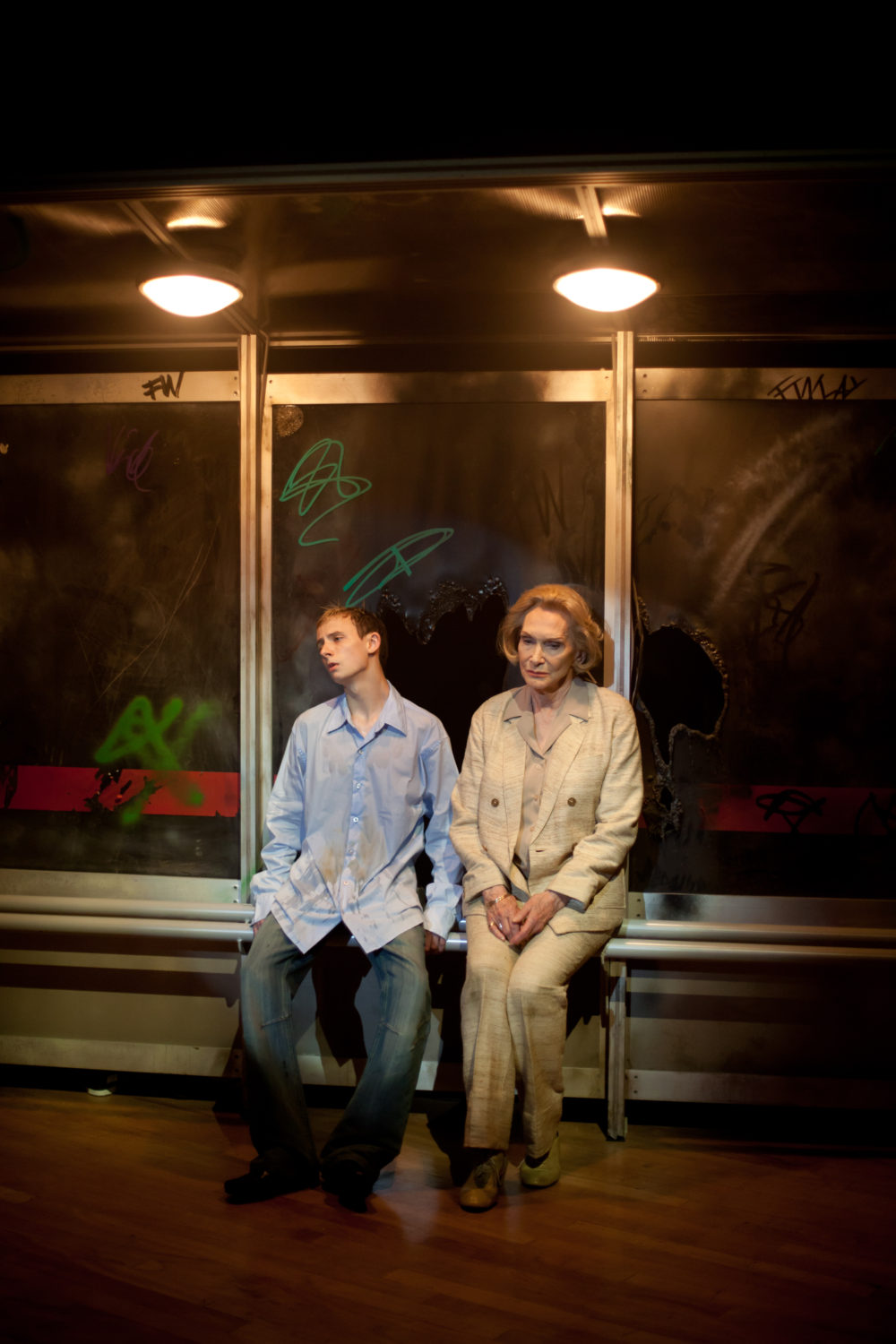
Set out as a promenade piece, the audience are shuffled from corner to corner as the movement changes. Starting in a living room not out of place in 1920’s Cwmdonkin Drive, we are transported to the scene of a battered boy racer car, the desecrated toilets of a particularly seedy night club, the sandy beach, and the dirty streets in between – including an empty midnight bus stop. The cast guide us as they move to the beats of the music, diving in close and occasionally nudging along, they emerge from the audience: one minute part of us, the next part of them.
The older, grandmotherly figure of Sian Phillips may have been a ghostly, under used presence, yet it is her primarily silent presence that provides the significance. She is representative of the generational divide between teenagers and their grandparents, yet her two shining moments, comforting the lost and lonely Darren Evans with a forgotten lullaby and her striking, powerful monologue for the finale binds those two generations together – they are not so different after all: a fact Dylan Thomas could well have agreed with and we should be “humbled by the thrash of love”.
What the piece lacks in dialogue and substantial narrative, it makes up for in fantastic style, with Frantic Assembly’s unique brand of vibrant, physical theatre. It is punctuated by a soundtrack with a solid beat – reminiscent of a night out clubbing – it entrances you, grabbing at the heartstrings. Whilst these teenagers present the unrelenting, negative side to growing up, it is a gritty realism that will make you think, either of your own past, or of those teenagers out on Swansea’s infamous Wind Street living their lives and searching for that someone.
Little Dogs continues until Sat 19 May at the Patti Pavilion, Swansea. Suitable for ages 15+. Tickets: £5-15. Info:www.taliesinartscentre.co.uk / 01792 602060

Monday, 23 April 2012

Clytemnestra - Theatre Review


Fri 20 Apr
Sherman Cymru

★★★★☆
Clytemnestra, an ancient Greek legend adapted for stage, is Sherman Cymru’s first major English language play since re-opening in February. Written by Gwyneth Lewis – former Welsh National Poet – Clytemnestra is her first stage play.
“When we’ve killed all the animals, men will be next”. Transported 200 years into the future, food is scarce and the human condition is stretched to its limit as families are forced to make sacrifices and wage war to survive. Agamemnon is no different: father and clan leader he has ventured out to barter for supplies, acting in the wider interest he exchanges younger daughter Iphigenia for trade routes. Only, his plan back fires as she is raped and killed and in her grief Clytemnestra goes mad, killing Agamemnon on his return.
Told from Clytemnestra’s point of view, the audience watch as she loses sight of reason and succumbs to the whispering torment of a Fury, hell bent on havoc and revenge. The Furies are an ancient race of God’s/Godessess adapted by Gwyneth into vengeful spirits, and they act as a perfect tool in Clytemnestra’s madness: wraiths within the main character’s shadows, they are the basest and most primitive part of the human psyche, demanding an eye of any eye. Played by Nia Gwynne and Adam Redmore, they are a constant presence on stage, adding an intense physicality to the play with their blend of graceful choreography and dark threats. Played brilliantly by Gwynne and Redmore, their creepy, contorted voices embody revenge.
Jaye Griffiths is powerful in her performance as Clytemnestra, pouring pure agony into her cries of grief and delivering her Fury led madness with conviction. As the voice of reason and family loyalty Rhian Blythe’s Electra is worried for her mother and easily fits to her moment of command. The chorus of abattoir workers provide light comic relief and normality against the outpouring of grief and calculated revenge. “Who’d be a leader? Better far to be a pleb”.
With terrifying brilliance, the soundtrack hits you full on a constant wall of wailing grief and post-apocalyptic percussion, putting the audience firmly in the world of the characters. The set is a simple but powerful statement of blood stained, stark white tiles and tall steel structures – the backdrop of a slaughterhouse.
Stripped down to its essential, the plot is simplistic and very easy to follow, the language ordinary and direct.  Yet for the minimalist approach the narrative seems to glance over some sections, barely giving the audience enough to bite into: Clytemnestra meeting Aegisthus is a very physical scene but the dialogue is sparse. What are Agamemnon and Cassandra? Are they lovers or victor and victim?
If you are expecting poetics on a grand scale, this may not be for you, as the poetic rhythm exists as an undercurrent that softens the ordinary language rather than build on it – to hear it you do have to listen carefully.
If you enjoy the Greek tragedy with a twist and the dark, eerie setting of a post-apocalyptic world then I couldn’t recommend it more. A terrifyingly beautiful play it serves up a healthy dose of the mad and macabre.
Clytemnestra continues at Sherman Cymru until Sat 5 May. Tickets are £15-£25. Info: 029 2064 6900 / www.shermancymru.co.uk

Friday, 20 April 2012

#NTW18 Social Media Call - The Radicalisation of Bradley Manning

What makes us come to the decisions make and do the things we do? What influences us? Bradley Manning is accused of making a decision that shook the world, a US soldier and only a few years ago a teenager in Haverfordwest, he is accused of releasing  thousands of US documents to Wikileaks, he faces a maximum life sentence in jail if found guilty and has no chance of parole. His story has touched people across the world and one only has to ‘Google’ him to discover a torrent of support and campaigns for his freedom.


Wednesday I attended the first NTW Social Media Call, intrigued I went along, knowing just how controversial the subject matter for NTW18 is. What I found was what makes NTW the theatre company it is: unique, intense and passionate theatre unafraid to address wider issues and still retain a sensitivity to the subject. At it's heart, this play is about Manning; - a misunderstood, rebellious and intelligent teenager and young man who became something akin to an anti-hero.

A semi-fictional account of Manning's life, the production mixes together his teenage life in Haverfordwest and life in the US Army. There are soldier's to direct you to your seats, but they behave far more like teachers.


The main stage space is surrounded by pillar's of  screen's, throughout the performance they display a multitude of images steering the audience from location to location: from Iraqi war images, army base and prison cell to snippets of the live streaming chat and web coverage of Manning's plight. They are also put into clever use by the cast as as prop's.


This is a snippet of rehersal's as they ran through scene's and cue's:


Institutions is the name of the game here as NTW exploit every potential in Tasker Milward, Cardiff High and Connah's Quay Schools. Just walking into Cardiff High to watch rehearsals was weird enough of a feeling, it's narrow, claustraphobic and dark corridors. The locations cotribute to the feelings of uniformity and being given orders. In his life, Bradley Manning, has gone from one institution to another: school, army and currently prison.

A play with a difference, the audiencce is not confined to the corridors or assembly hall's of schools. Fully hyper-conected you can join in on a live webcast of some performances, taking part in a forum and even having some comments displayed on the screen's during the play.

The Radicalisation of Bradley Manning continue's until 21st April in Cardiff before moving on to Flintshire. 
For more information visit: http://nationaltheatrewales.org or search #NTW18.

Friday, 13 April 2012

Clytemnestra - Rehersal Preview & Social Media Call

Tues 10 April

Invited by the Sherman to a Social Media Call, I was excited at the prospect of peeking behind closed doors. Clytemnestra is one of the first in house Sherman plays since its February re-opening.  


Rather intriguingly I caught them going over the intricacies of one particular scene, where Aegisthus meets Clytemnestra for the first time and the furies finally grow quiet. This particular scene seemed to embody the entire play: a dark, post-apocalyptic atmosphere accentuated by loud, bone-chilling music with the Furies whispering devil’s thoughts of pain and anger to the character’s – heightening their emptions. The Furies, played by Nia Gwynne and Adam Redmore, are as constant on the stage as the main characters – representing their subconscious and driving them to revenge, as Director Amy Hodge explains. Whilst the Furies do lend the play its movement focus and physicality it is not all choreography and dance as the play is full of rich poetic language and the “Classical, normal, dramatic angle” where it utilises the traditional Chorus form.


A highly controversial character in Greek mythology, Clytemnestra is at once wronged wife and victim, an adulteress, distraught mother and a murderer. Married to Agamemnon, the sacker of Troy, legend has her killing him at the behest of her lover Aegisthus. Clytemnestra is played by acclaimed actress Jaye Griffiths.  In this dark, futuristic version toga’s are completely absent, oil has run out and wars are waged over food as human endurance is pushed to its limit by war and hunger. The creative team -Greek Designer takis (yes it is spelt without a capital letter), Composer Simon Thorne; Choreographer John Stjernholm and lighting designer Lee Curran – are all ready to ready to take its dangerous and hungry world to audiences. All to frame the story with dramatic sound (which is quite true at rehearsals) and movement it is a perfect story to create an explosive and imaginative setting.
Listening in, the rehearsals are as fun as they are hard work, apparently 'elegant robot' and 'French and Saunders Run' are technical dance terms as the cast use familiar terms to remember movements and timing.


As Director Amy Hodge assures, “you won’t need to know the Greek myths to understand the play [as] it is very clear and simple story telling” whilst it is inspired by, and the myths are ever present “you could come to it knowing nothing and still be able to track it all…. The story is able to stand on its own in the current climate.” Amy described Clytemnestra as a “Beautiful piece of work, it is saying important things, exploiting the potential of the theatrical form and it is hugely ambitious.”
An intriguing, challenging and brilliant looking play, I am keen to see it next week.


Clytemnestra is showing at Sherman Cymru 18 April-5 May.
Tickets are available here and remember under 25s tickets are half price

Questions asked of Director Amy Hodge by fellow blogger Katie Brown (Blog here)

Monday, 26 March 2012

Wasted - Theatre Review

Sherman Cymru
Photo: Richard Davenport
Sat 24 March

★★★☆☆

Wasted is the debut play by Kate Tempest, the writer and performance poet currently taking hip-hop and performance poetry scenes by storm.

Ted, Danny and Charlotte are three childhood friends bound by the death of a friend. As the 10-year anniversary appears, the trio look back on their own lives, asking whether one lost life has led them to waste their own.

Now, Charlotte (Lizzy Watts) is a disillusioned teacher, unable to inspire the classroom, Ted (Cary Crankson) wears a city suit yet pushes paper around his desk with monotony, and Danny (Ashley George) is an aspiring musician living the good life but failing to get anywhere.

The play opens with the three characters storming on stage to launch into fascinating observations on London life. It is these sections – full of Tempest’s spellbinding verse - sporadically placed throughout that hold the power: rhythmically perfect monologues and layered conversations filled with strong messages about living life.
As theses sections fade into the more traditional theatre form the momentum drops, leaving the piece with little depth. The characters never reach nor realise their goal - living their lives as before -leaving us with only superficial glances into their personalities and the potential emotional themes left unrealized: skimmed over as if insignificant. Even as Danny wrestles with his love for Charlotte and his old life and Ted tries to convince him that a relationship is about work and knowing what the other person needs, with Ted then bemoaning his own stagnant relationship - the routine of nothingness – it all feels sluggish and very superficial. In a moment of epiphany Charlotte books a flight to go travelling yet she never leaves -with to many excuses not to go she can’t move on physically, a state of paralysis.

The mammoth performances of Crankson, George and Watts deliver both the poetic language and ordinary dialogue with brilliant intensity and energy.  They are accompanied by a raving soundtrack that pumps the life through the audience and feeds the lyrical power. Cai Dyfan’s set is effective yet simple, backed by a screen not out of place in a club with multi-functioning speakers scattering the floor to be used as seats, stages and flashing lights.  The screen provides backdrops and a montage of images depicting the daily dissatisfaction and frustrations of the characters.
As the characters promise to throw out conventions as they confess to being “the awkward ones in the theatre” Tempest seems to wrestle with her want to express expansive ideals and observations on society and theatrical conventions instead of using her talent to throw out those conventions and create something new.

Tuesday, 6 March 2012

A Provincial Life - Theatre Review

#NTW17

Sherman Cymru

5 March 2012


Provincial Life see’s the return of National Theatre Wales for their newest round of productions. Staging it in the newly refurbished Sherman Cymru it is written and directed by acclaimed director Peter Gill who returns to his native city after a glittering career spanning half a century.

Originally adapted from Chekhov’s short story ‘My Life’ in 1966, it brings with it a timely poignancy, resonating with much of the audience, as today many struggle with the financial consequences of social mobility, and the continuing search for equality. Following Misail we watch as a young man struggling to reconcile his position of privilege with that of the working life in 1890’s Russia: a time when social conventions were under scrutiny and political ideal’s changing, Karl Marx having only died in 1883. Misail’s eventually shuns his status and inheritance to take up a work man’s life, only to regain some social standing in his marriage to Maria. His hopes of success in their venture are later dashed when she realises their failure and deserts him and the estate to return to privilege.

Much of Chekhov’s work is a careful weave of tragedy and comic genius, and A Provincial Life capture’s this mix eloquently, as Ivan (John Paul-Macleod) provides humorous interludes against the expansive emotional ponderings and familial arguments. It is Boris (Lee Haven-Jones) the flighty, loveable, forever on the move, yet responsible doctor who provides the debating table for Misail’s reckonings. Nicholas Shaw’s portrayal of Misail is faultless yet his character is not the life and soul of the piece, its life and soul is made up of the endearing, loveable and bizarre character’s Misail seems to attract. The strong cast adds a Welsh flavour as the Chekhovian wit fits the stronger accents like a glove.

Set against a stark backdrop of wooden boards the props are a fabulous, lavish mix period furniture and intricate fixtures, employed perfectly by the cast. There is a seamlessness between scene changes as the costumed ensemble act as stage hands, in some ways giving their portrayal of the lower classes, of servants an extra dimension and clarity. The lighting was simple and very effective, depicting the turn of the seasons as well as reflecting the scene’s mood. The cliff hanger style ending at the interval was a very ingenious technique, with the cast mid step as the curtain dropped

At almost 3 hours the production did feel over-long, particularly for a short-story adaptation. There were moments where the piece intentionally slows, giving the audience chance to digest and ponder the ideas and lives before them. These moments stretch the emotional connections the audience has gained a little too far.

Chekhov’s My Life has Misail as the narrator and whereas A Provincial Life has him as the protagonist and the parade of monologues are a testament to the story’s original form, as a result the play sits on the fence and the levels of action are inconsistent. At the finale the format fully shifts and Misail finally takes up the narrator role, standing alone and bereft in the final scene to recount the death of his sister – the price she pays for flouting conventions – and the ideal’s he has come to terms with. The shift in theatrical device is a little disorientating, having been given Misail as hero and idealist until that point. In saying that, the finale is emotional and heart rending: a testament to the convincing and compelling skills of the whole NTW team.

Continues at Sherman Cymru until 17TH March
Info: www.shermancymru.co.uk